
The salt air that gives South Florida its charm is also slowly working against your home. So is the humidity, the relentless sun, and the storm season that arrives every year. Designing a luxury home in Miami, Palm Beach, or West Palm Beach is not the same as designing one in Connecticut or California, and the people who understand that best are the ones who grew up here. The right South Florida interior designers bring local knowledge that protects your investment and shapes a home that feels like it truly belongs.
Anyone can order beautiful furniture. What separates a great South Florida home from a merely expensive one is the hundred small decisions made by people who know how this region actually behaves. This is a look at why local roots matter for high-end homes across the area, what native experience changes in the finished result, and how our team puts decades of South Florida knowledge to work across three very different markets.
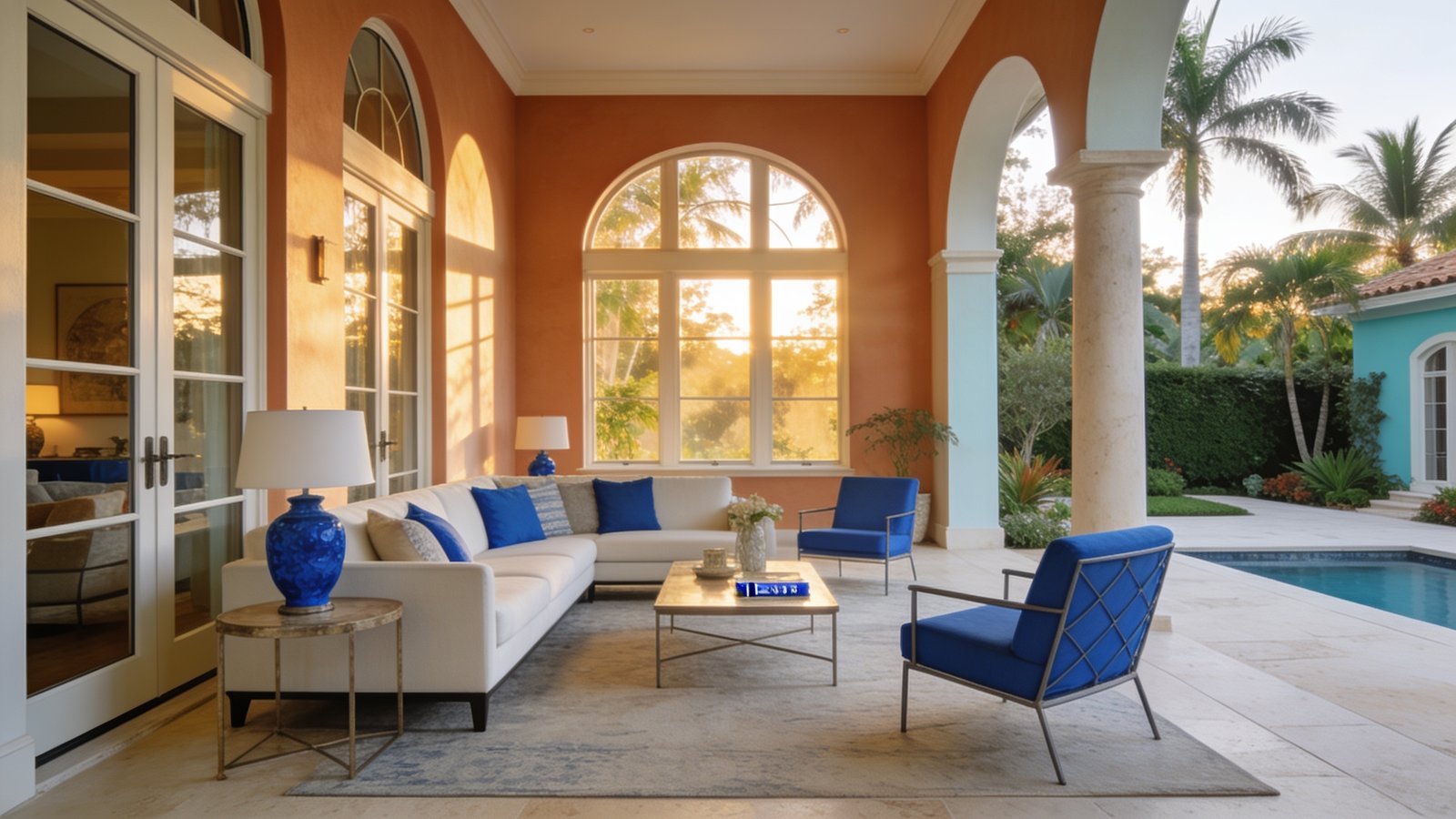
What being a native South Floridian really changes
Local roots are not a marketing line. They show up in practical decisions that affect how a home looks on day one and how it holds up ten years later.
A designer who has lived through the Atlantic hurricane season for decades understands how coastal exposure treats a home. Miami-Dade and Broward counties sit in a High-Velocity Hurricane Zone, which means impact-rated glass, specific structural requirements, and a level of build quality that designers from other regions often underestimate. A local team designs with those realities built in rather than discovering them mid-project.
Salt air is just as unforgiving. It corrodes ordinary hardware, pits low-grade metals, and degrades finishes that were never made for the coast. Humidity warps the wrong woods and feeds mildew in fabrics that are not rated for it. Direct subtropical sun fades textiles and art at a speed that surprises people who move here from cooler climates.
Native designers solve these problems before they happen. The choices they make quietly protect a home from the environment most homeowners only think about after something fails.
- Impact-rated glazing and finishes suited to the High-Velocity Hurricane Zone
- Marine-grade and corrosion-resistant hardware for coastal exposure
- Performance fabrics and rugs built for humidity and strong light
- Woods and stones chosen for stability in a hot, humid climate
- Familiarity with local codes, permits, and inspection requirements
Local relationships save time, money, and stress
A great interior is built, not just specified. That requires a network of trades, fabricators, and suppliers who do excellent work and show up when they say they will.
A firm that has worked here for decades has already vetted those people. The custom cabinetmaker who understands island estates, the upholsterer who works in performance textiles, the stone yard with the right slabs in stock, the installers who know how to get a sofa into a 30th-floor unit through a single service elevator. These relationships are invisible in a finished photo, but they are the difference between a project that runs smoothly and one that stalls for months.
Local knowledge also speeds up the parts of a project clients never see. Permitting timelines, condo association rules, and inspection schedules vary widely across South Florida. A team that navigates them every week keeps your home moving.
Local heritage shapes better design
South Florida is not one design story. It is several, and each market has its own visual language that a native designer reads instantly.
Palm Beach grew out of the Mediterranean Revival vision of architects like Addison Mizner in the 1920s, with barrel-tile roofs, arched openings, loggias, and shaded courtyards. The island still protects that legacy through strict landmark standards. Coral Gables carries a parallel Mediterranean grandeur from city founder George Merrick, while Miami Beach gave the world its celebrated Art Deco and MiMo districts. West Palm Beach blends 1920s Mission and Mediterranean homes in districts like El Cid with a fast-rising modern skyline along the water.
Knowing this history matters because the best interiors respond to their setting. A home should feel connected to its architecture and its city, not dropped in from a catalog. A designer who understands why a Mizner courtyard works, or how an Art Deco facade wants to be furnished, makes choices that feel inevitable. That instinct is hard to fake and easy to spot.
The South Florida roots behind our team
Shuster Design Studio has called Fort Lauderdale home for more than 40 years, and our four decades of work across South Florida runs through every project we take on. Our team includes native Floridians who learned this region from the ground up, not from a relocation guide.
Principal designer Gage Hartung is a native Floridian who has been designing since 1991. He grew up inside the construction world: his father was a successful general contractor in Palm Beach County who took him to job sites and taught him how homes are designed and put together. That early, hands-on education shaped his eye for detail, scale, and product knowledge, and it gave him a builder’s understanding of how a beautiful design actually gets made in this climate.
Project manager Clayton Weidner, also a native South Floridian, has been with the firm since 1993 and oversees projects from in-house design through jobsite supervision. A graduate of the Art Institute of Fort Lauderdale, he brings decades of regional construction knowledge to every build, the kind of experience that anticipates problems before they reach the homeowner.
Together, they reflect what sets a homegrown firm apart: design talent paired with deep, practical knowledge of how South Florida homes come together. You can see the result across our portfolio of South Florida homes, and you can visit our Fort Lauderdale studio to talk through your project in person.
How local knowledge looks in Miami, Palm Beach, and West Palm Beach
The same firm, applied across three distinct markets, adapts to each one instead of forcing a single style on all of them.
Miami
In Miami, our team designs for water views, glass-walled towers, and a confident, contemporary aesthetic. The work centers on framing bay and ocean views, managing intense light, and selecting materials that stand up to bayfront and oceanfront exposure. High-rise living also brings logistics, from elevator access to association rules, that a local team handles routinely.
Palm Beach
On the island of Palm Beach, the focus shifts to historic estates and landmark-sensitive updates. Here, success means honoring Mediterranean Revival heritage and the island’s preservation standards while quietly modernizing comfort and function. Restraint and craftsmanship matter more than statement-making.
West Palm Beach
In West Palm Beach, we move between restoring period homes in districts like El Cid and Flamingo Park and designing crisp interiors for new waterfront towers along Flagler Drive. The city’s dual identity rewards a team comfortable in both worlds.
Questions to ask before you hire
Use these questions to judge whether a designer truly knows South Florida or simply happens to work here.
- How long have you designed homes in this specific market?
- Have you completed projects in my community or building?
- How do you choose materials for our climate and coastal exposure?
- Which local trades and suppliers do you work with regularly?
- How do you handle local permits, codes, and any historic review?
The answers reveal a lot. A designer with real local depth will speak specifically about neighborhoods, materials, and process. One without it will keep the answers general.
Work with a team that knows South Florida
Your home deserves a design team that understands the region as well as it understands design. Whether your project is a Miami high-rise, a Palm Beach estate, or a West Palm Beach restoration, start a conversation with our team to put four decades of South Florida experience to work.
Call us at (954) 462-6400 or request a consultation to get started.
Frequently Asked Questions
Why does it matter if my interior designer is from South Florida?
A designer who grew up here understands the realities of the climate, from humidity and salt air to hurricane season, and knows which materials hold up. They also know the local architecture, trades, and permitting, which keeps your project on schedule and built to last.
Do Miami, Palm Beach, and West Palm Beach really need different design approaches?
Yes. Miami leans contemporary and tower-driven, Palm Beach is rooted in Mediterranean Revival and strict landmark rules, and West Palm Beach blends historic districts with new waterfront construction. A local team adjusts to each market instead of using one template everywhere.
What should I ask before hiring an interior designer in South Florida?
Ask how long they have worked in the area, whether they have completed homes in your specific community, how they handle coastal materials and codes, and which local trades and suppliers they work with. Local depth shows up fast in the answers.
How long has Shuster Design Studio worked in South Florida?
Shuster Design Studio has served South Florida for more than 40 years from its base in Fort Lauderdale. Our team includes native Floridians whose roots in the region inform every project across Miami, Palm Beach, West Palm Beach, and beyond.
Does local experience help with waterfront and high-rise homes?
It is essential. Waterfront and high-rise homes face salt air, intense sun, and building rules that vary by city and tower. A team with local experience designs around those factors from the start, protecting both the look and the longevity of your interior.
How much does it cost to hire an interior designer in South Florida?
Cost depends on the size of your home, the scope of work, and the level of finishes you choose. Most luxury projects are quoted as a custom proposal after an initial consultation rather than a flat price. Our team reviews your goals and your home, then provides a clear scope and estimate so you know what to expect before any work begins.
What is the difference between an interior designer and a decorator?
A decorator focuses mainly on surface elements like furniture, color, and accessories. Our design professionals handle those plus space planning, construction details, lighting, and coordination with builders and trades. For a renovation or new home in South Florida, that broader scope matters, because the structure and the finishes need to work together from the start.
What does an interior designer actually do?
A great deal more than choosing furniture. Our team plans how a space functions, selects materials and finishes, designs kitchens and baths, develops lighting, sources furnishings, and coordinates the trades who build it all. On many projects we are involved from the first floor plan through the final accessory, making sure every decision supports the whole.
When should I hire an interior designer for my project?
The earlier the better. Bringing our team in before construction or a major renovation lets us shape the floor plan, lighting, and finishes while changes are still easy and inexpensive. For a new build, that often means joining during the design or pre-construction phase. Even for a furnishing project, early involvement leads to a more cohesive result.